
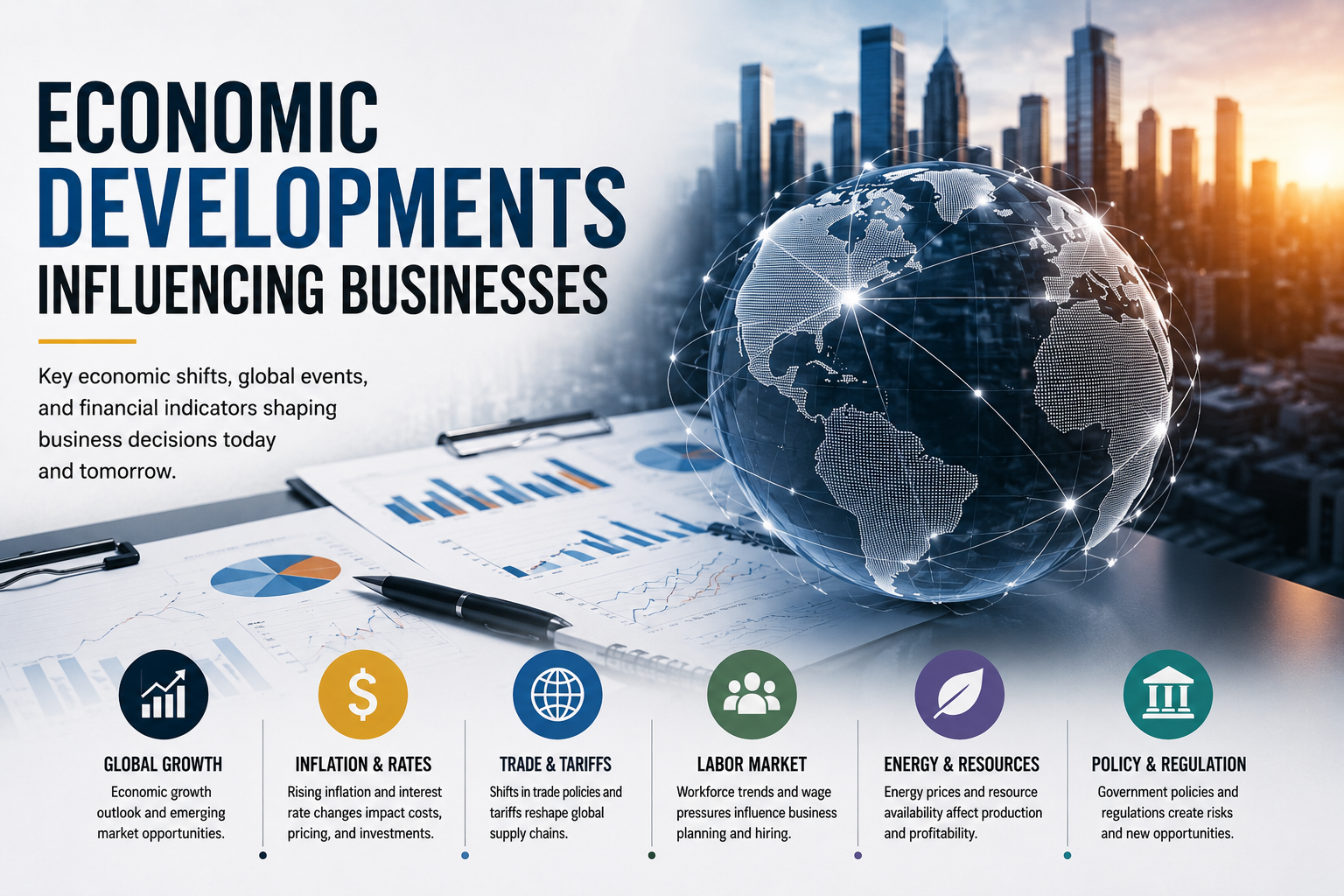
Explore the latest Economic Developments influencing businesses, including inflation, interest rates, consumer spending, trade, and technological change.
Economic Developments Influencing Businesses
Economic conditions play a significant role in shaping how businesses operate, invest, and grow. Changes in inflation, consumer spending, government policies, and global trade can affect operating costs, customer demand, and long-term planning. Understanding key Economic Developments allows business leaders to make informed decisions, manage risks, and identify opportunities in an ever-changing marketplace.
Businesses that regularly monitor economic changes are better prepared to adapt to uncertainty and remain competitive.
Inflation Affects Operating Costs
Inflation is one of the most closely watched Economic Developments because it influences the cost of raw materials, transportation, utilities, and employee wages. Rising inflation can reduce profit margins if businesses do not adjust pricing or improve operational efficiency.
Organizations that manage expenses carefully and optimize their operations are better equipped to handle inflationary pressures.
Interest Rates Shape Investment Decisions
Interest rates directly affect borrowing costs for businesses and consumers. Higher rates make loans more expensive, often reducing business investment and consumer spending. Lower interest rates generally encourage expansion, equipment purchases, and new business ventures.
Monitoring interest rate changes helps companies make smarter financing decisions.
Consumer Spending Drives Revenue
Consumer spending is a major driver of business performance. When people feel financially confident, they are more likely to purchase goods and services. During periods of economic uncertainty, spending often slows as households become more cautious.
Understanding consumer behavior enables businesses to adjust pricing, marketing, and inventory strategies effectively.
Gross Domestic Product (GDP)
Gross Domestic Product (GDP) measures the total value of goods and services produced within an economy. Strong GDP growth usually indicates healthy business activity, while slower growth may suggest reduced market demand.
Businesses often use GDP trends to guide expansion plans and long-term investment decisions.
Labor Market Conditions
Employment levels influence both workforce availability and customer purchasing power. Low unemployment often increases competition for skilled employees, while high unemployment may reduce consumer demand but expand the available labor pool.
Businesses should monitor hiring trends and wage growth to support workforce planning.
Global Trade and Supply Chains
International trade policies, transportation costs, and geopolitical events continue to affect supply chains around the world. Businesses that depend on imported goods or export products must remain aware of changing trade conditions.
Diversifying suppliers and improving logistics strategies help reduce the risks associated with global disruptions.
Currency Exchange Rates
Exchange rate fluctuations affect companies involved in international business. Changes in currency values influence import costs, export competitiveness, and overseas revenue.
Businesses operating globally often develop financial strategies to manage foreign exchange risks effectively.
Government Policies and Regulations
Government decisions related to taxation, labor laws, environmental standards, and business incentives have a direct impact on business operations. Staying informed about policy changes allows organizations to remain compliant while identifying opportunities for growth.
A proactive approach helps businesses adapt to regulatory changes with minimal disruption.
Technology Investment Continues to Grow
Digital transformation remains one of the most important Economic Developments affecting modern businesses. Investments in artificial intelligence, automation, cloud computing, cybersecurity, and data analytics improve productivity and operational efficiency.
Organizations that embrace technology often gain a stronger competitive advantage and adapt more quickly to changing market conditions.
Business Confidence and Investment
Business confidence reflects how optimistic organizations are about future economic conditions. Higher confidence often encourages investment, hiring, and expansion, while lower confidence may lead businesses to delay major decisions.
Monitoring confidence levels provides valuable insight into future economic activity.
Preparing for Future Economic Developments
Businesses should regularly review economic reports, monitor industry trends, maintain financial flexibility, and develop contingency plans for changing market conditions. Companies that respond proactively to Economic Developments are better positioned to seize opportunities while minimizing risks.
Long-term success depends on informed planning and the ability to adapt to economic change.
Conclusion
Economic Developments influence nearly every aspect of business, from operating costs and customer demand to investment decisions and strategic planning. Inflation, interest rates, GDP growth, consumer spending, labor markets, global trade, and technological innovation all shape the business environment. By monitoring these developments and adapting accordingly, businesses can strengthen resilience, improve decision-making, and achieve sustainable long-term growth.
FAQs
1. What are Economic Developments?
Economic Developments are changes in economic conditions, policies, and market activities that affect businesses, consumers, and financial markets.
2. Why are Economic Developments important for businesses?
They help businesses anticipate market changes, manage financial risks, make informed investment decisions, and identify growth opportunities.
3. Which Economic Developments have the greatest impact on businesses?
Inflation, interest rates, GDP growth, consumer spending, labor market conditions, government policies, and global trade are among the most influential factors.
4. How often should businesses monitor Economic Developments?
Businesses should review major economic reports regularly, especially monthly and quarterly, while staying informed about significant policy and market changes.
5. How can businesses prepare for changing Economic Developments?
Businesses can strengthen financial planning, diversify supply chains, invest in technology, monitor market conditions, and maintain flexible strategies to adapt to changing economic environments.
