
European Drone Manufacturing Expands as Hungary Opens Major New Production Facility
Europe's effort to build more of its technology supply chain at home is reaching an industry that has rapidly moved from a specialist niche into mainstream business: drones.
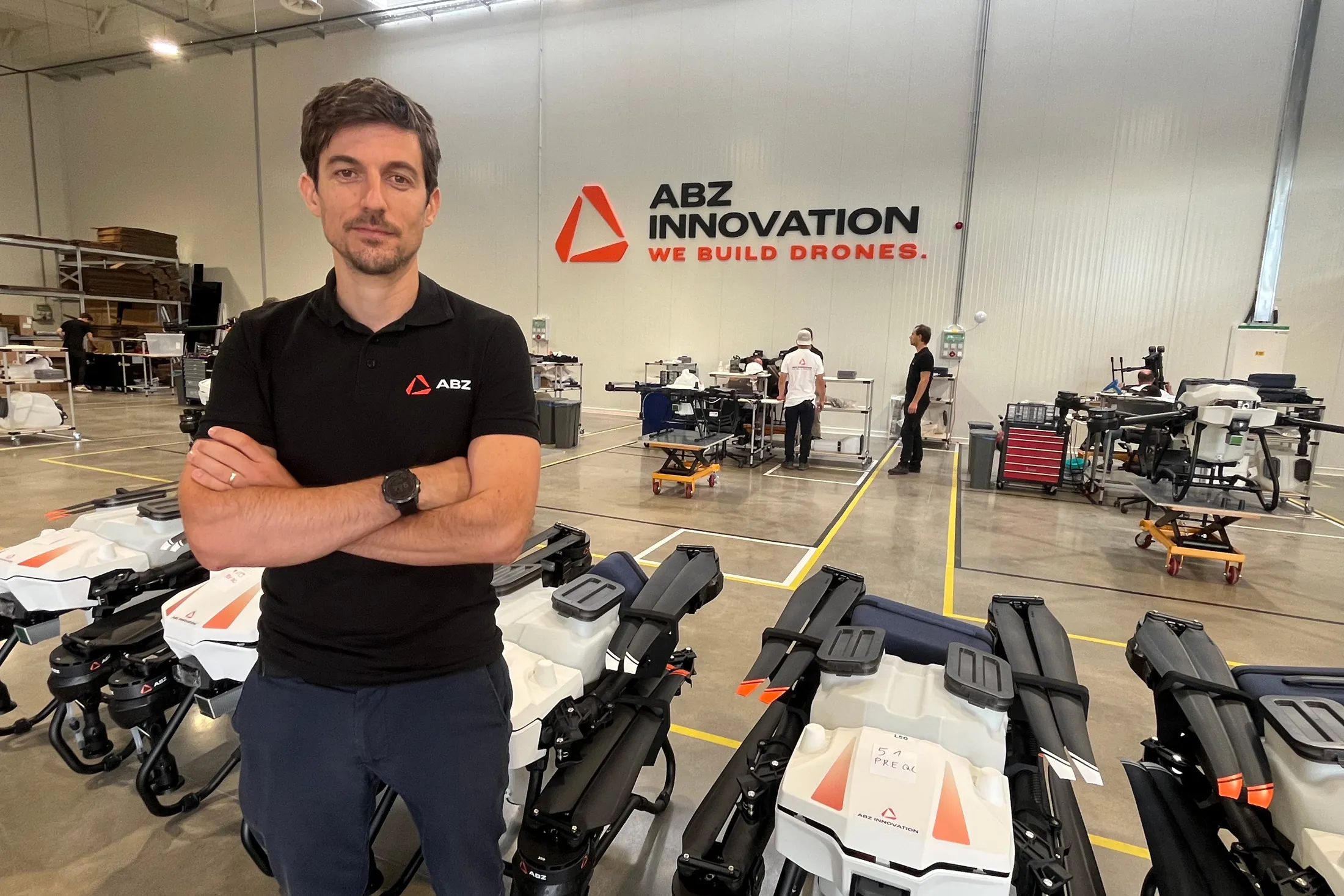
Hungarian civilian-drone manufacturer ABZ Innovation opened a €7 million ($8 million) factory extension in Szentendre, Hungary, on September 17, saying the additional capacity could help it increase production fivefold by the end of next year.
The expansion is significant not simply because another factory has opened.
It reflects a broader industrial question confronting Europe.
As drones become increasingly useful in agriculture, infrastructure inspection, mapping and other commercial applications, should European businesses continue relying heavily on imported equipment, or should more of that manufacturing capacity exist closer to their customers?
ABZ is betting that demand for European-made systems will grow.
From Specialist Technology to Industrial Tool
For years, many consumers associated drones primarily with photography.
That image is increasingly outdated.
Commercial drones can now perform jobs that once required helicopters, specialised vehicles or teams of workers.
Farmers can use them to monitor crops and apply treatments.
Energy companies can inspect infrastructure.
Surveyors can map difficult terrain.
Construction companies can track progress across large sites.
Industrial operators can inspect locations that may be dangerous or expensive for employees to reach.
As those applications expand, drones are becoming less like gadgets and more like pieces of industrial machinery.
That changes what customers expect from manufacturers.
Reliability, maintenance, software, training and replacement components can become as important as the aircraft itself.
Thousands of Drones a Year
ABZ says its expanded facility will be capable of producing around 2,000 drones annually on a single shift.
Running two shifts could increase that figure to approximately 3,500 units per year, according to CEO and co-founder Karoly Ludvigh.
The company describes the site as one of Europe's largest civilian drone-production facilities.
Those numbers remain modest compared with mass-produced consumer electronics.
But industrial drones are a different market.
They can be larger, more specialised and configured for specific professional applications.
The significance therefore lies not only in the number of aircraft produced but in Europe's ability to develop an industrial ecosystem around them.
Agriculture Is a Major Opportunity
One of the clearest commercial applications is farming.
Large agricultural operations constantly need information.
Which parts of a field are under stress?
Where are crops developing unevenly?
Where should treatment be concentrated?
Traditionally, collecting that information across large areas can require considerable labour and time.
Drones equipped with cameras and specialised sensors can survey fields much more quickly.
Some agricultural drones can also carry liquids or other materials for targeted application.
That can allow farmers to treat specific areas rather than approaching every hectare in exactly the same way.
The economic argument is straightforward: better information can potentially help businesses use labour, chemicals, water and time more efficiently.
Supply Chains Are Becoming Part of the Buying Decision
There is another reason European manufacturing matters.
Where technology is manufactured has become a strategic business issue.
Global companies learned during the pandemic how vulnerable long supply chains could become when factories, ports and transportation networks were disrupted.
Geopolitical tensions have since added another layer of uncertainty.
For drones, the issue is especially noticeable because China has developed an enormous manufacturing ecosystem around the technology.
European manufacturers are trying to establish alternatives.
ABZ's chief executive said the factory expansion could contribute to reducing dependence on Chinese production. The company's sales are currently dominated by customers in Europe and the United States.
That does not mean European manufacturers can simply replace Asian supply chains overnight.
Modern drones contain numerous electronic components that themselves come from international suppliers.
But final manufacturing, engineering and product development can still create greater regional control.
Investors Are Backing the Expansion
The project has attracted capital from multiple countries.
Reuters reported that the expansion was financed by Assembly Ventures of the United States, Germany's Vsquared Ventures and Hungary's Day One Capital.
That investor mix is notable.
It suggests the opportunity is being viewed beyond Hungary's domestic market.
If civilian drones continue moving deeper into agriculture and industrial operations, companies capable of manufacturing specialised systems at scale could serve customers across multiple regions.
For investors, that creates a different proposition from betting on consumer-drone popularity.
The focus becomes industrial productivity.
Europe's Manufacturing Challenge
Europe has strong engineering capabilities but faces intense competition in several advanced manufacturing industries.
Semiconductors, batteries, electric vehicles, renewable-energy equipment and drones have all raised similar questions.
How much technology should Europe manufacture itself?
Which parts of the supply chain are strategically important?
And how can European factories remain competitive against regions with larger manufacturing ecosystems or lower production costs?
There is no simple answer.
Manufacturing locally can improve supply resilience, but it does not automatically make a product cheaper.
European producers still need to compete on performance, reliability and cost.
Automation Will Matter
Expanding a factory is only one part of scaling production.
Manufacturers also need to increase output without allowing costs or quality problems to rise at the same speed.
Automation can help.
Standardised production processes make it easier to produce larger volumes while maintaining consistency.
Testing systems become especially important for aircraft.
A commercial customer needs confidence that sensors, navigation equipment, batteries and communications systems will work reliably.
As drone fleets become larger, manufacturers may increasingly resemble traditional aerospace or automotive suppliers in the way they manage quality.
The Drone Business Extends Beyond Hardware
Another important development is that the value of a commercial drone does not stop at the aircraft.
Software can become equally important.
A farmer may care less about owning a flying machine than receiving useful information about crops.
An infrastructure company may want inspection reports rather than raw video.
A construction company may want automated measurements.
That creates opportunities for businesses offering data analysis, fleet management, mapping and artificial-intelligence tools alongside hardware.
The winning companies may therefore be those that combine aircraft with useful software rather than simply manufacturing the drone itself.
Skilled Jobs Could Follow
Advanced manufacturing can also create employment beyond assembly lines.
Drone companies require mechanical engineers, electronics specialists, software developers, technicians and maintenance professionals.
A growing domestic industry can also support component suppliers and training organisations.
The economic effect of a manufacturing facility therefore depends partly on whether a wider cluster develops around it.
Europe already has deep expertise in automotive and aerospace engineering.
Some of those skills can transfer into autonomous and remotely operated aircraft.
Regulation Remains Important
Drones operate in physical airspace, which means growth cannot depend on manufacturing alone.
Regulators must consider safety, privacy and how unmanned aircraft interact with traditional aviation.
Commercial operators may need approvals depending on the type of operation, aircraft and location.
Manufacturers therefore have to design products that satisfy both customers and regulators.
Clear rules can help companies invest because they provide greater certainty about which commercial applications will be permitted.
Overly fragmented regulation, on the other hand, can make expansion more difficult.
Civilian Drones Have a Different Economic Story
Discussion of drones increasingly becomes mixed with military developments.
But civilian applications deserve separate attention.
Agricultural spraying, surveying, mapping and infrastructure inspection represent commercial markets with their own customers and economics.
ABZ's Szentendre operation is focused on civilian drones.
That distinction matters because the long-term commercial opportunity depends on whether businesses can demonstrate that drones save money or perform work more effectively than existing methods.
Novelty alone will not sustain an industrial market.
Productivity might.
A Small Factory With a Bigger Industrial Message
A €7 million expansion is tiny compared with the multibillion-dollar semiconductor and automotive plants being constructed around the world.
Yet its significance goes beyond the investment figure.
It shows how Europe's manufacturing strategy is spreading into emerging industries.
ABZ says the enlarged Szentendre facility can produce 2,000 civilian drones annually on one shift and as many as 3,500 with two shifts, while the company aims to quintuple overall production by the end of next year.
The bigger question is whether European manufacturers can turn growing demand into a sustainable regional industry.
If drones become routine tools for farms, infrastructure companies and industrial operators, the companies supplying them could occupy an increasingly important part of Europe's technology-manufacturing economy.
The drone industry may have started in the air.
Its next competition is increasingly happening on factory floors.