
ISLAMABAD, Pakistan
Former Pakistan Prime Minister Imran Khan is once again at the centre of national and international attention as questions surrounding his health, imprisonment and access to medical treatment add a new dimension to Pakistan’s continuing political tensions.
Khan, the founder of Pakistan Tehreek-e-Insaf (PTI) and one of the country’s most influential political figures, remains imprisoned at Adiala Jail in Rawalpindi. His detention has continued for more than three years, while legal proceedings involving the former prime minister remain a major part of Pakistan’s political landscape.
The latest developments have focused heavily on Khan’s medical condition and the arrangements for his treatment.
Supreme Court Intervention Brings Health Issue Into Focus
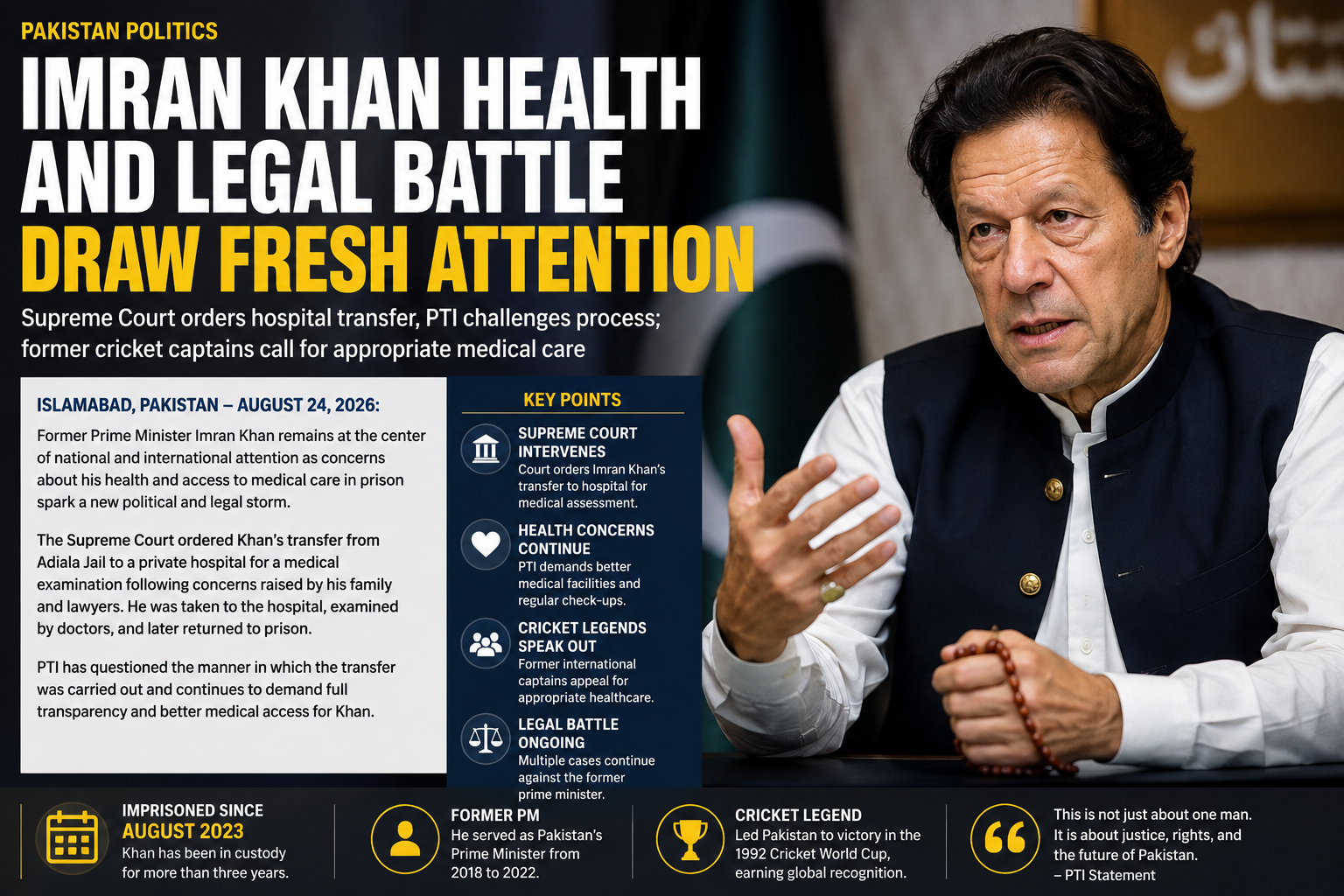
Concerns surrounding Khan’s health reached Pakistan’s Supreme Court, which ordered that the former prime minister be transferred from prison to a private hospital for medical assessment.
The intervention followed concerns raised by his family and legal representatives regarding his health and access to appropriate medical care.
Khan was subsequently taken from prison for medical examinations before being returned to Adiala Jail after doctors assessed him.
The hospital visit, however, did not end the controversy.
PTI representatives raised objections over how the transfer and examination were carried out and continued to demand greater transparency regarding Khan’s medical treatment. The party has also pursued legal action connected with the handling of the hospital transfer.
The government, meanwhile, has maintained that the former prime minister received medical attention and that authorities complied with their responsibilities.
The competing accounts have turned what might otherwise have been a medical matter into another significant political and legal dispute.
PTI Continues to Press for Medical Access
For PTI, Khan’s health has become an increasingly important issue.
Party leaders and members of his family have repeatedly sought improved access to doctors, lawyers and relatives. They argue that an individual in state custody must have access to appropriate healthcare regardless of political circumstances.
The issue has attracted particular attention because Khan is not an ordinary prisoner. He is a former prime minister, the leader of a major political movement and a former international cricket captain whose public profile extends far beyond Pakistan.
His supporters therefore continue to closely follow every development concerning his imprisonment.
The latest medical dispute has also created fresh questions about how authorities should balance prison regulations, security requirements and the medical rights of high-profile detainees.
Former Cricket Captains Join Calls Over Khan’s Healthcare
The debate has now extended beyond Pakistani politics.
A group of former international cricket captains has appealed to Pakistan’s leadership to ensure that Khan receives appropriate medical care.
The intervention carries symbolic significance because Khan’s international reputation was established long before his political career.
As captain of Pakistan’s national cricket team, Khan led the country to victory in the 1992 Cricket World Cup. That achievement made him one of the most recognisable Pakistani sports personalities internationally.
His transition from cricket to politics eventually led to the creation and rise of PTI, followed by his election as prime minister in 2018.
The involvement of prominent figures from the cricket world demonstrates how developments surrounding Khan continue to generate attention outside Pakistan’s traditional political circles.
More Than Three Years Since Imprisonment Began
Khan has been imprisoned since August 2023 and has faced numerous legal cases since leaving office.
He served as Pakistan’s prime minister from 2018 until April 2022, when his government was removed following a parliamentary vote of no confidence.
His political confrontation with the country’s governing institutions intensified after his removal from office.
Khan has faced cases involving corruption allegations, state gifts, classified information and other matters. Some convictions have subsequently been suspended or overturned, while other legal proceedings and sentences have continued to affect his imprisonment.
One of the most significant cases involves the Al-Qadir Trust matter, in which Khan and his wife, Bushra Bibi, were convicted. Khan has denied wrongdoing and has consistently argued that the cases brought against him are politically motivated.
Pakistani authorities and political opponents have rejected claims that the judicial process is simply a political campaign against him.
As a result, the dispute surrounding Khan is no longer about a single court case. It has developed into a broader national argument over politics, institutions, accountability and the future direction of the country.
Imran Khan Remains a Major Political Force
Despite his imprisonment, Khan continues to command significant political attention.
PTI remains an important force in Pakistan, while Khan’s supporters continue to call for his release and challenge the cases against him.
His imprisonment has also created an unusual political situation: although physically removed from public campaigning, he continues to influence national political discussion.
Statements from his lawyers, relatives and party representatives regularly generate national headlines, while developments in his court cases can quickly become major political events.
For supporters, Khan remains the central figure of a movement demanding political change and institutional reform.
For critics, the former prime minister must face the same legal accountability processes as any other political leader.
These sharply different interpretations have helped ensure that his imprisonment remains one of Pakistan’s most divisive political issues.
Health Dispute Could Shape the Next Phase
The current debate surrounding medical treatment could now become an important part of Khan’s wider legal battle.
The Supreme Court’s involvement has placed additional attention on the responsibility of authorities to provide appropriate medical care while he remains in custody.
PTI is expected to continue pursuing legal avenues concerning Khan’s treatment and prison conditions.
At the same time, the government faces the challenge of demonstrating compliance with court directions while maintaining security and prison procedures.
Further medical examinations or court hearings could therefore produce new developments in the coming days and weeks.
Pakistan Watches Closely
For Pakistan, the continuing Imran Khan dispute represents more than the circumstances of one former prime minister.
It reflects wider tensions involving political competition, judicial authority, public trust and the relationship between political movements and state institutions.
Khan’s supporters continue to demand his release, while his legal cases remain before Pakistan’s judicial system.
His opponents maintain that political popularity should not exempt any leader from legal proceedings.
What happens next will depend heavily on decisions made inside Pakistan’s courts and on developments surrounding his imprisonment and medical treatment.
For now, Imran Khan remains inside Adiala Jail, but his influence on Pakistan’s political conversation remains substantial.
The latest controversy over his healthcare has once again demonstrated that developments involving the former prime minister can quickly move beyond the courtroom or prison walls and become matters of national debate.
As legal proceedings continue and questions surrounding his health remain under scrutiny, Pakistan is likely to see continued political attention focused on one of the most consequential and controversial figures in its recent history.
